
COTS Outbreak at Racha Noi: A Call for Reef Monitoring and Action
Field observations from Racha Noi Island, Phuket, Thailand
Report by Niphon Phongsuwan
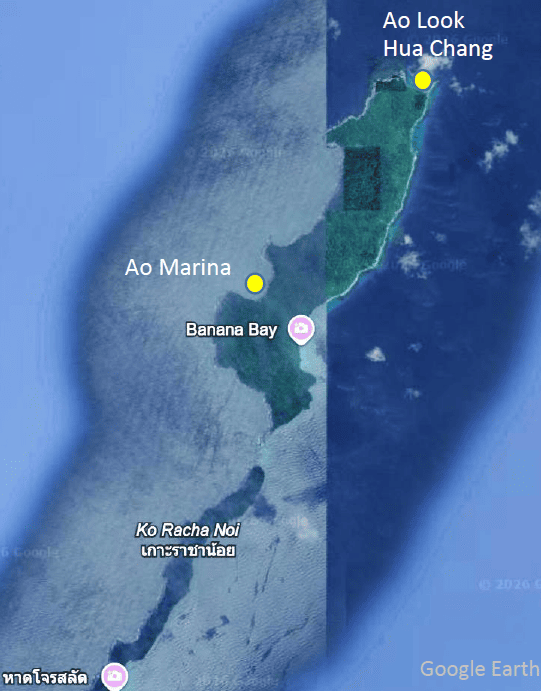
At Ao Marina, divers collected a total of 56 COTS. Based on the mapped coral reef area, the estimated density was approximately 33 individuals per hectare, indicating a severe outbreak according to the practical reference levels used in this assessment. The most visibly affected coral was Montipora aequituberculata, a leafy coral species.
At Ao Look Hua Chang, 13 COTS were collected, giving an estimated density of approximately 13 individuals per hectare. This suggests that the site may be experiencing an initial-stage outbreak.
The estimated densities were calculated by comparing the total number of COTS collected during the operation with the mapped areas of coral reef at each site. These figures provide an indication of the situation at each site, although they should not be interpreted as a complete count of every COTS present.
Understanding the severity of a COTS outbreak
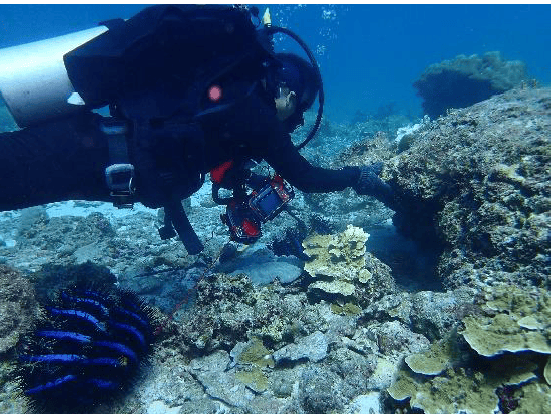
Crown-of-thorns starfish are natural inhabitants of coral reef ecosystems. However, when their populations increase substantially, they can consume large amounts of living coral and cause extensive damage to reefs.
For practical reef monitoring and management, COTS densities of approximately 10 individuals per hectare and more than 30 individuals per hectare can be used as indicative reference levels for an initial-stage and a severe outbreak, respectively.
These figures should not be regarded as fixed or universal thresholds. The actual impact of COTS depends on several factors, including the condition of the reef, live coral cover, the availability of preferred coral prey, and other environmental pressures. Some reefs may be able to support small COTS populations for extended periods with relatively little impact, while others may be more vulnerable.
Therefore, COTS density should always be interpreted in the context of local reef conditions. These reference levels are intended to provide a simple and practical guide for divers and reef managers to recognise potential outbreaks and identify sites that may require further assessment or management action.
A simple way for divers to visualise COTS density
Numbers such as 10 or 30 individuals per hectare may be difficult to visualise underwater. One way to make them easier to understand is to imagine that COTS are evenly distributed across the reef.
Under this simplified assumption:
· At 10 COTS per hectare: there would be approximately one COTS every 32–45 metres.
· At 30 COTS per hectare: there would be approximately one COTS every 18–25 metres.
 These distances are only a visual guide based on a hypothetical, evenly distributed pattern. In nature, COTS are not necessarily distributed uniformly; they may gather in particular areas. Therefore, even if the average density across the entire reef is relatively low, aggregations of COTS in certain areas can still cause severe damage within these localised areas. Furthermore, these aggregations may serve as a source of further spread into adjacent areas.
For divers, the important point is to stay observant. Seeing several COTS in a relatively small area, particularly where there are signs of coral damage, may indicate a situation that deserves closer attention.
Help us protect our coral reefs
Divers and dive operators play an important role in monitoring the health of coral reefs. Your observations can help identify potential COTS outbreaks at an early stage and support timely management responses.
If you encounter an unusually high number of COTS, or notice areas of coral damage that may be associated with their feeding activity, please report your observations to the relevant marine authorities or local reef management teams. Photographs, dive-site locations, and approximate numbers can all be useful information.
Your observations can make a difference.
Help us monitor and protect Thailand's coral reefs.